Back to projects
Vision-Language Model Development
A.X-4.0-VL-Light
SK Telecom's open-source Vision Language Model built on the A.X-4.0-Light LLM, optimized for Korean vision-language understanding and enterprise deployment.
My Contributions
- Defined the model’s direction and strengths by focusing on token efficiency and enhanced understanding of Korean culture and Korean-language documents.
- Developed the training pipeline, reviewing frameworks such as Megatron-LM, NeMo, and DeepSpeed.
- Designed and validated training strategies based on PLM and instruction-tuned models.
- Selected the VLM architecture to highlight the strengths of the A.X-4.0-VL model.
- Coordinated external collaborations for academic evaluations, Korean document understanding, and the development of a proprietary VLM benchmark for domestic certifications.
- Built a comprehensive evaluation pipeline integrating the proprietary benchmark, AI Hub datasets, and lmms-eval for VLM performance assessment.
What is A.X-4.0-VL-Light?
A.X 4.0 VL Light (pronounced “A dot X”) is a vision-language model (VLM) optimized for Korean vision and language understanding as well as enterprise deployment. Built upon A.X 4.0 Light, it has been further trained on diverse multimodal datasets, with a particular focus on large-scale multimodal Korean datasets, to deliver strong performance in domestic business applications.
Results
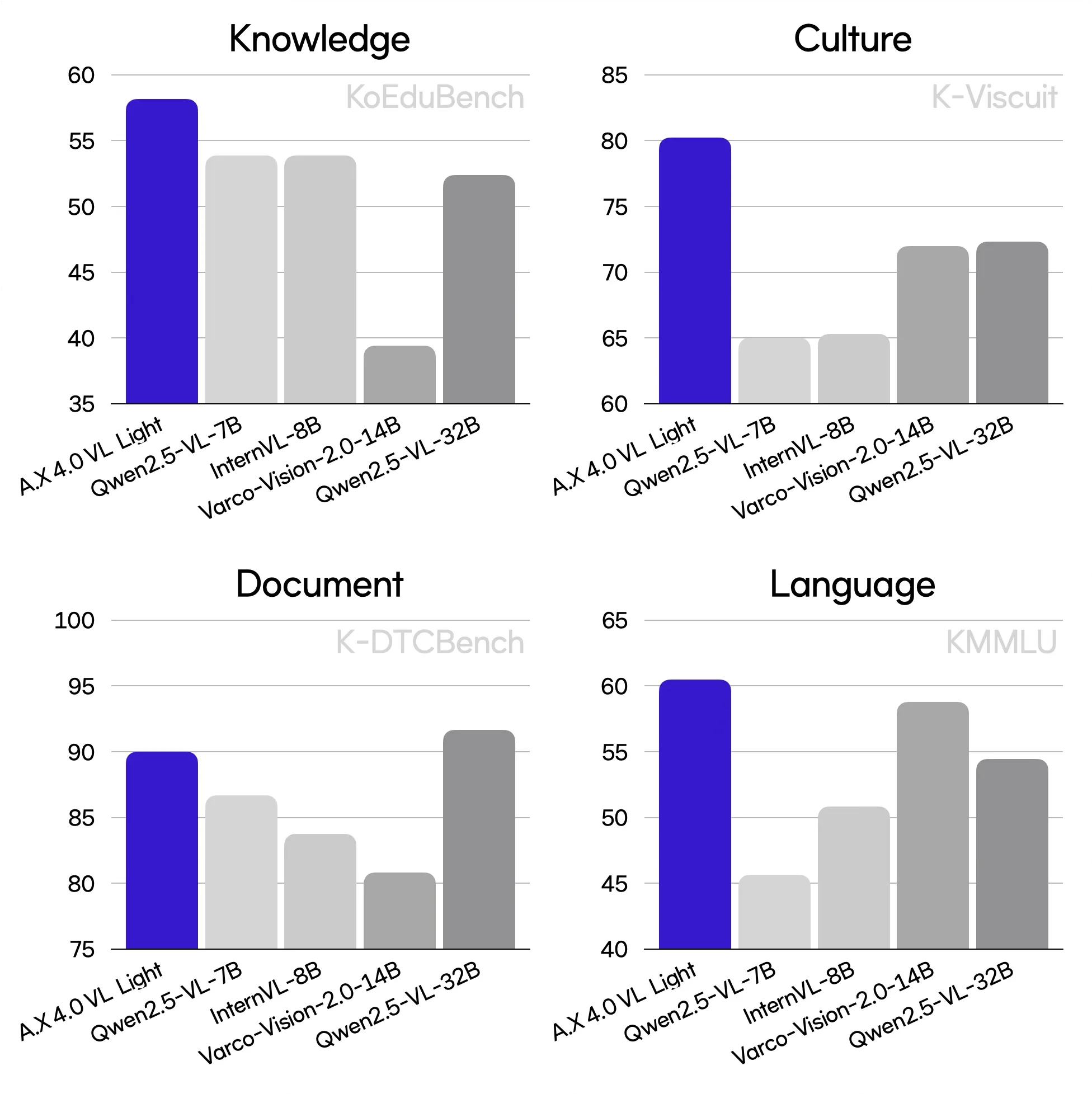
- Superior Korean proficiency in vision and language — Achieved an average score of 79.4 on Korean image benchmarks, outperforming Qwen2.5-VL-32B (73.4) despite a significantly smaller model size. On Korean text benchmarks, recorded an average of 60.2, comparable to VARCO-VISION-2.0-14B (60.4) while using only half the model size.
- Deep cultural understanding — Scored 80.2 on K-Viscuit, a multimodal benchmark for cultural and contextual comprehension in Korean, exceeding Qwen2.5-VL-32B (72.3).
- Advanced document understanding — Attained 89.8 on KoBizDoc, a benchmark focused on complex document structures including charts and tables, performing comparably to Qwen2.5-VL-32B (88.8).
- Efficient token usage — Uses approximately 41% fewer text tokens than Qwen2.5-VL for the same Korean input, enabling more cost-effective processing.